Best Time for Makkah Ziyarat in Ramadan: Complete Guide
By the Makkah Ziyarat Taxi team | Updated for Ramadan 1448 AH (2027)
The best time for Makkah Ziyarat in Ramadan is the early morning, from shortly after Fajr until about mid-morning, ideally during the first ten days of the month. Roads are calmer, the air is cooler, and your energy is at its best. Late afternoon visits to drive-by sites also work well, as long as you are back at your hotel well before iftar. Avoid the hour before Maghrib, the hours after Taraweeh, and the last ten nights if you can.
Why Timing Matters More in Ramadan

Outside Ramadan, a Ziyarat trip in Makkah is mostly a question of weather and traffic. In Ramadan, three more things change the picture.
First, you are fasting. Most pilgrims go about thirteen hours without food or water, so your energy for walking, climbing and standing drops through the day. Second, your day is built around prayer: Fajr, Dhuhr, Asr, Maghrib with iftar, Isha and Taraweeh, and for many, late-night worship at the Masjid al-Haram. Third, Makkah is far busier than usual. Millions of Umrah pilgrims arrive, and the roads around the Haram fill up at predictable hours.
Good Ziyarat planning in Ramadan means fitting visits into the gaps. Done well, you see the Cave of Hira, the Cave of Thawr, Jannat al-Mu’alla and the other historical sites calmly, without losing a prayer or your strength for worship.
One point of clarity first. Visiting these places is not a required part of Umrah or Hajj, and no ritual is attached to climbing a mountain. Ziyarat is about learning the history of the Seerah, reflecting, and strengthening your connection to the story of Islam. Keep it simple, keep your intention sincere, and do not let it compete with your obligations or your time in the Haram.
Ramadan 2027 Dates and What They Mean for Your Plans
Ramadan 1448 AH is expected to begin on Monday, 8 February 2027, with Eid al-Fitr expected around 9 March 2027. Saudi Arabia confirms the start by moon sighting, so dates can shift by a day. Laylat al-Qadr is most often sought on the odd nights of the last ten days, and 27 Ramadan is expected around 6 March.
This early-year timing helps you. Ramadan in February and early March means Makkah’s daytime weather is much gentler than in the summer months, which makes outdoor Ziyarat more comfortable than it was for pilgrims in past decades. Days are warm, evenings are mild, and the heat that makes midday visits unbearable in summer is far less severe. Still, direct sun on a mountainside in the early afternoon is tiring when you are fasting, so the timing advice below still applies.
The Best Time of Day for Ziyarat in Ramadan
Best: after Fajr until mid-morning
This is the window we recommend most. After Fajr and a light rest, the city is quiet, the light is soft, and you have fresh energy even if you woke for suhoor. Traffic toward the Haram eases because most pilgrims are resting after the night’s worship. A typical start is around 7:00 to 7:30 a.m., finishing by late morning.
This window suits the sites that involve getting out of the car and walking: the base of Jabal al-Noor, Jabal Thawr, Jannat al-Mu’alla, Masjid Aisha and Masjid Ji’ranah.
Good: mid-to-late afternoon, with a hard stop
After Asr, a shorter drive-and-view trip can work well for sites you only need to see from the roadside or step out briefly. The key is a hard stop. In Makkah, the one to two hours before Maghrib are the most congested of the entire day, because everyone is heading toward the Haram or their hotels for iftar. If you leave the last site later than about an hour before Maghrib, you may break your fast in the car.
If that happens, tell your driver in advance. A private driver can carry dates and water for you, and can stop safely at Maghrib so you can break your fast and pray without rushing.
Possible: after Taraweeh, for those who prefer night
Some pilgrims prefer cooler night air and use the late hours for sites such as the area around Jabal al-Noor, which is lit at night. This can be peaceful, but it comes with trade-offs. Many sites are less staffed at night, the Haram area is crowded after Taraweeh, and you may be tired. We suggest this only for fit travelers who are comfortable with a late night, and not for elderly family members.
Avoid: the hour before Maghrib and the post-Taraweeh surge
These two periods combine peak crowds, peak traffic and peak tiredness. If you must travel then, build in extra time and keep the plan to one stop.
Summary: The best time of day for Makkah Ziyarat in Ramadan is after Fajr to mid-morning. A shorter afternoon trip after Asr is the second-best option, provided you are back before the pre-Maghrib rush.
The Best Part of Ramadan for Ziyarat
The first ten days: calmest
The first third of Ramadan is generally the quietest. Crowds are present but manageable, hotels are easier to move between, and your energy is high. If your schedule is flexible and your main goal is a comfortable, unhurried Ziyarat, choose this period. Saudi tourism authorities and major Umrah operators consistently describe the early part of Ramadan as calmer than the last ten nights.
The middle ten days: busy but workable
Expect steadier crowds, particularly on Thursday evenings and Fridays. Early morning visits still work well. Book your transport a day or two ahead for fixed dates.
The last ten days: busiest
The final ten nights draw the largest crowds of the month. Hotel prices rise, roads around the Haram can slow to a crawl, and many pilgrims spend their nights in worship and their days sleeping. If you are visiting then, plan Ziyarat for the early morning after Fajr, keep trips short, and confirm your pickup time the evening before. Many travelers choose to complete their Ziyarat earlier in Ramadan so the last ten nights remain free for worship, and we think that is sensible advice.
Practical rule for weekdays
Tuesday to Wednesday mornings are usually easier than Fridays and weekends. Friday has the Jumu’ah prayer, which adds a heavy surge of people around the Haram from late morning.
Site-by-Site Timing Guide
Distances below are approximate road distances from the Masjid al-Haram area, and travel times vary with traffic. In Ramadan, add extra time on every leg. Check opening conditions on the day, since access to some sites can change.
Cave of Hira and Jabal al-Noor
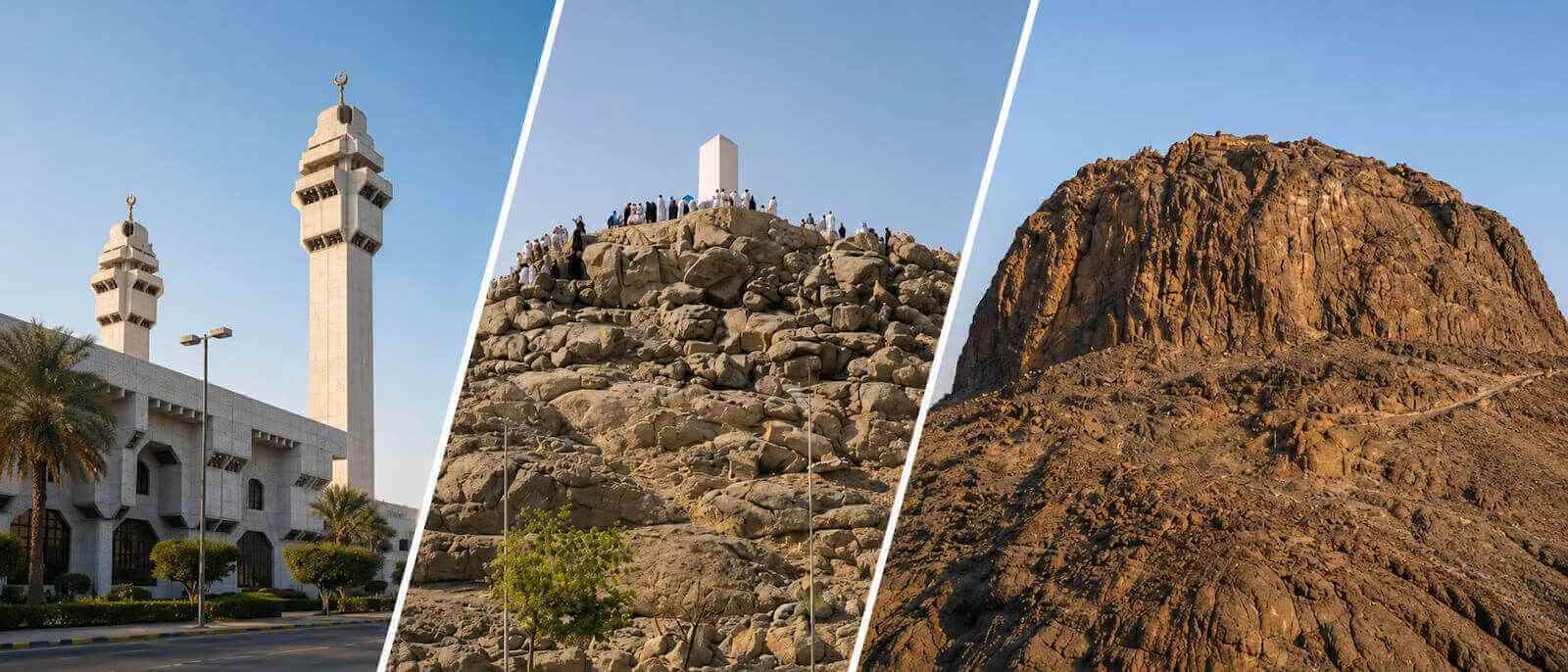
The Cave of Hira, on Jabal al-Noor, is where Prophet Muhammad ﷺ received the first revelation. It lies roughly 4 to 5 km from the Haram, about 15 to 25 minutes by car in normal traffic.
The climb to the cave is long, steep and uneven, and many people take one to two hours for the round trip. In Ramadan, we recommend visiting only right after Fajr, when you are fresh, and only climbing if you are fit and well hydrated. Fasting and steep stairs are a poor mix after midday. For most elderly travelers, viewing the mountain from the base and reflecting on the story is the wiser and kinder choice. You can book a private Cave of Hira taxi or Jabal al-Noor taxi through Makkah Ziyarat Taxi, and your driver will wait while you visit.
Cave of Thawr and Jabal Thawr
The Cave of Thawr is where the Prophet ﷺ and Abu Bakr (may Allah be pleased with him) sheltered during the Hijrah. It is a little farther, around 5 to 7 km south of the Haram. The mountain is steep and rocky, and the climb is more demanding than Hira. The same advice applies: go early, and treat the base viewpoint as a complete visit if climbing is not suitable. A private Cave of Thawr taxi lets you combine it with Hira on one morning.
Jannat al-Mu’alla
This historic cemetery near the Haram, around 1.5 to 2 km away, is where many Companions and members of the Prophet’s family ﷺ are buried, including Khadijah (may Allah be pleased with her). Visits are short and quiet. Access rules, including who may enter, are set by the authorities, so ask your driver for current guidance. Early morning is calm. Keep the visit respectful and brief.
Masjid Aisha (Tan’eem)
Masjid Aisha is a well-known miqat for people already in Makkah who wish to perform another Umrah. It is roughly 6 to 7 km from the Haram. In Ramadan this site is extremely busy in the evenings, as many pilgrims enter ihram here after Taraweeh. If you are not performing Umrah here, go in the morning. If you are, plan your return carefully, because getting back toward the Haram late at night can take a long time. A Masjid Aisha taxi with a pre-arranged return pickup is far easier than hunting for a ride.
Masjid Ji’ranah
Masjid Ji’ranah, on the road toward Taif, is another miqat, associated with the Prophet ﷺ entering ihram for Umrah after the battle of Hunayn. It is farther out, around 25 km, so allow at least one to two hours for the round trip with a stop. It suits a calm morning outing, and a private vehicle is much more practical than public transport.
Mina, Muzdalifah, Arafat, Jamarat
Outside the Hajj days, these sites are open for visits and reflection, though the Mina tent areas are largely empty. Mina is around 5 km from the Haram, Muzdalifah around 12 km, and Arafat around 20 km. The Jamarat complex is in Mina. Visiting them in Ramadan gives you context for Hajj, but there is no reward-specific act attached, so keep it light and choose cooler hours. Our Mina, Arafat, Muzdalifah and Jamarat transfers can be combined into one half-day trip.
Masjid Nimrah and Masjid Al-Khaif
Masjid Nimrah sits on the edge of Arafat, and Masjid Al-Khaif is in Mina. Both are brief stops that fit naturally into a Mina and Arafat itinerary.
Why Mountain Ziyarat Is Hard on Elderly Family Members
If you are planning a trip with parents or grandparents, the main challenge is not the distance. It is the combination of long walks from drop-off points, uneven ground, heat, crowds, steps, fasting, and long periods of sitting in a poorly suspended vehicle on roads near the mountains.
Three things reduce the strain:
- A smooth, stable ride. Roads near Jabal al-Noor and Jabal Thawr are paved, but you meet speed bumps, sharp turns, and stop-start traffic. A softer ride makes a big difference to people with back, hip or knee pain.
- Close, predictable drop-off. Every extra hundred metres matters. A private driver who knows the access points, waits for you, and brings you back to the exact same door reduces walking.
- A calm, flexible schedule. Plan fewer stops and longer pauses. In Ramadan, a two-stop morning is better than a rushed five-stop day.
Always consider your relative’s health first. If someone has a heart, breathing or mobility condition, speak to their doctor, and remember that fasting has recognized exemptions in Islam for illness and age. Ziyarat should never be a reason to put anyone at risk.
Why a GMC Yukon Suits Luxury and Elderly-Friendly Ziyarat
For travelers who want maximum comfort and privacy, a full-size SUV is a natural choice. The GMC Yukon, which is part of the Makkah Ziyarat Taxi fleet, is popular for VIP Ziyarat and luxury Umrah transport in Makkah for several practical reasons.
Ride comfort
The Yukon is a large, heavy SUV with a smooth, stable ride that handles speed bumps and rough patches better than a standard sedan. This is the single most valued feature for elderly passengers on mountain-adjacent routes. We always recommend sitting in the second row, where motion is gentlest.
Space and privacy
The cabin has room for a family or a small party along with luggage, prayer mats, water, and a wheelchair or walker where folding models are available. The rear air-conditioning keeps the cabin cool through a morning of repeated stops. Privacy is a real consideration for families, and a private, air-conditioned vehicle with a dedicated driver keeps your group together, free from strangers.
Easier day planning
With a private Yukon, you decide the order of stops, the pace, and the time you spend at each. If your father needs a break at Jabal Thawr, you take one. If you want to pray Dhuhr at a specific masjid, you stop there.
Honest note on boarding
A full-size SUV sits higher than a sedan. Some elderly passengers find a Staria or Hiace van easier to enter, because the floor is lower and the doors slide. If your relatives struggle with high steps, tell us when you book, and we will help you choose between the Yukon, a Hyundai Staria, or a Toyota Hiace. Our fleet also includes the Toyota Camry, Mercedes, Coaster and Bus for different group sizes.
GMC Yukon Makkah Taxi Price: What Affects the Cost
Travelers often ask for a single price for a GMC Yukon in Makkah. In practice, the cost depends on several factors, so a quote is more reliable than a rough figure you might see in a list:
- Route and number of stops. A two-stop Hira and Thawr morning costs less than a full Mina, Arafat, Muzdalifah and Ji’ranah day.
- Duration. Half-day and full-day Ziyarat tours are priced differently from a one-way transfer.
- Timing in Ramadan. Demand rises through the month, and the last ten nights are the busiest.
- Vehicle class. A Yukon costs more than a Camry or Hyundai Staria because of its size and comfort.
- Extras. Hotel pickup and drop-off, waiting time at sites, and return transfers.
Before you pay, ask for the total in writing, covering the route, waiting time, number of passengers and vehicle. Confirming the price in advance protects you from surprises. For a current quote for a Yukon or any other vehicle, message us on WhatsApp at +966 57 4915 372.
Sample Ramadan Ziyarat Plans
Plan 1: Elderly-friendly morning (about 3 hours)
- 7:00 a.m. Hotel pickup in a private Yukon or Staria.
- 7:30 a.m. Jabal al-Noor viewpoint at the base, with a short talk on the first revelation.
- 8:30 a.m. Jabal Thawr base viewpoint.
- 9:30 a.m. Optional short stop at Jannat al-Mu’alla.
- 10:00 a.m. Return to the hotel in time for rest.
Plan 2: Half-day historical tour (about 4 to 5 hours)
Hira and Thawr in the morning, followed by Mina, Jamarat, Masjid Al-Khaif and Arafat. Return before noon so you can rest, pray and prepare for iftar.
Plan 3: Full-day multi-stop trip (for fit travelers, early in Ramadan)
An early start, with Hira, Thawr, Mina, Muzdalifah, Arafat, Masjid Nimrah and a late-morning finish. Choose the first ten days of Ramadan for this plan.
Plan 4: Masjid Aisha and Ji’ranah morning
This suits pilgrims planning another Umrah. Go to Masjid Ji’ranah first, then Masjid Aisha, so you can enter ihram at the right miqat and return to the Haram at a manageable hour.
Etiquette and Practical Tips
- Dress modestly and comfortably. Wear sturdy, flat shoes for any mountain base visit.
- Carry water for after iftar, a hat or umbrella, and a small prayer mat.
- Respect the sites. Do not engage in practices not taught by the Prophet ﷺ, such as touching, rubbing or leaving items at the caves or graves.
- Photography. Photography is generally allowed at outdoor viewpoints, but be respectful at graves and near people praying, and follow any signs.
- Keep your phone charged, and save your driver’s number in advance.
- Take your time. If an elderly relative tires, shorten the trip. Ziyarat is about reflection, not distance covered.
- Check official sources. The Ministry of Hajj and Umrah and the Nusuk platform publish crowd and permit guidance, which is helpful for planning Umrah around Ramadan.
How to Book a Private Ziyarat Taxi
Booking is simple and takes only a few minutes:
- Message us on WhatsApp at +966 57 4915 372 or visit https://makkahziyarat.taxi.
- Tell us the date, your hotel, the number of travelers, and the sites you want.
- Mention any elderly passengers, wheelchair needs, or luggage.
- Choose your vehicle, whether the GMC Yukon for VIP comfort, a Hyundai Staria for families, or a larger Hiace, Coaster or Bus for groups.
- Receive your confirmed quote, pickup time and driver details.
- Your driver collects you from your hotel and brings you back after the tour.
We offer hotel pickup and drop-off, door-to-door Ziyarat tours, flexible multi-stop trips, and half-day and full-day tours. In Ramadan, we recommend booking at least a day ahead, and earlier for the last ten nights.
FAQs
1. What is the best time for Makkah Ziyarat in Ramadan?
The best time is early morning, shortly after Fajr until mid-morning, and the best part of the month is the first ten days. These are the calmest and most comfortable periods.
2. Can I do Ziyarat while fasting?
Yes. Fasting does not prevent Ziyarat, but plan short, calm trips in the morning, carry water for iftar, and avoid long climbs in the afternoon.
3. Is it better to do Ziyarat before or after iftar?
Most travelers do better in the morning. After iftar, roads and the Haram area become crowded, and many people are tired after a long day.
4. Which days are busiest for Ziyarat in Ramadan?
Fridays, weekends, and the last ten nights of Ramadan are the busiest. Tuesday and Wednesday mornings tend to be calmer.
5. Is the Cave of Hira climb possible in Ramadan?
It is possible for fit travelers, but the climb is steep and long. Go right after Fajr, take water for later, and skip it if you feel unwell. The base viewpoint is a good alternative.
6. Is Ziyarat part of Umrah?
No. Visiting historical sites is not a required act of Umrah or Hajj, but many pilgrims visit them to learn the Seerah and reflect.
7. What is the best vehicle for elderly family members?
A full-size SUV such as the GMC Yukon offers a smooth ride and comfort, while a Hyundai Staria or Toyota Hiace is easier to board for those who struggle with high steps. We help you choose when you book.
8. How much does a GMC Yukon taxi cost in Makkah?
The price varies with the route, duration, number of stops, and Ramadan demand. Ask for a written quote on WhatsApp before you confirm.
9. Can the taxi pick me up from my hotel?
Yes. We offer hotel pickup and drop-off and door-to-door Ziyarat tours.
10. How long does a Ziyarat tour take?
A short two-stop trip takes about three hours. A half-day tour takes four to five hours. A full-day tour covers more sites but is best done early in Ramadan.
11. Can I visit Masjid Aisha and Masjid Ji’ranah on the same trip?
Yes. Both are miqats, and a private taxi can combine them in one morning, with Ji’ranah first and Masjid Aisha second.
12. When does Ramadan 2027 start?
Ramadan 1448 AH is expected to begin on Monday, 8 February 2027, subject to the moon-sighting announcement by Saudi Arabia.
13. Is it better to book a private taxi than a shared tour?
For families and elderly travelers, a private taxi gives you control over the schedule, the pace and the stops, with no waiting for other passengers.
14. Can I bring a wheelchair?
In many cases, yes, particularly a folding wheelchair. Tell us when you book so we can match the vehicle and plan the drop-off points.
Final Thoughts
The best time for Makkah Ziyarat in Ramadan is the early morning, ideally in the first ten days, with a hard stop well before the pre-Maghrib rush. Keep your plan modest, protect your time for worship, and travel in the most comfortable way you can, especially with elderly family members.
If you are planning a VIP, family-friendly or luxury Ziyarat, we would be glad to help. Visit https://makkahziyarat.taxi or message us on WhatsApp at +966 57 4915 372 for a quote, a recommended itinerary, and a private vehicle that suits your group.