24/7 Late Night & Early Morning Ziyarat Tours in Makkah: Complete Guide
By the Makkah Ziyarat Taxi team | Private Ziyarat transport in Makkah
Makkah is busiest at exactly the hours most visitors choose for sightseeing. By 10 a.m. in summer the heat is heavy, the roads around the Haram are slow, and the mountain paths at Jabal al-Noor are crowded. That is why more pilgrims are now asking for Ziyarat after Isha, in the quiet hours before Fajr, or straight after Fajr prayer.
Short answer: yes, you can do a Ziyarat tour in Makkah late at night or early in the morning, and for many travellers it is the better way to do it. A private driver makes it practical, because you are not waiting for a bus, hunting for a taxi at 3 a.m., or rushing back to the Haram. For elderly parents, a spacious SUV such as a GMC Yukon adds privacy and a more comfortable ride on the winding roads near the mountains.
This guide explains the best time windows, what each Ziyarat site is like after dark and at dawn, how to plan a night tour safely, what to expect from a luxury SUV, and how booking works with Makkah Ziyarat Taxi.
Why do Ziyarat at night or before sunrise?
There are four practical reasons, and most of them come down to comfort.
Cooler air. Makkah’s daytime temperatures in the warmer months regularly pass 40°C. Climbing steps, standing at a historic site, or waiting beside a car in that heat is hard on anyone, and harder on older people. After Isha and before sunrise the air is noticeably gentler.
Lighter traffic. The roads around the Haram and the routes toward Mina, Arafat and Ji’ranah slow down in the afternoon and around the main prayers. Late at night and in the pre-dawn hours the same trips are shorter and calmer.
A quieter atmosphere. Many people say the sites feel different when there are fewer voices and fewer phones raised for photos. It is easier to pause, reflect and make dua.
It fits around worship. Plenty of pilgrims want to keep the daytime free for Tawaf, Sa’i, rest, and the five prayers in the Haram. A Ziyarat tour in the small hours or just after Fajr leaves the rest of the day undisturbed.
There is a trade-off worth being honest about. Some sites have set opening arrangements, and some paths are dark. Night Ziyarat works best when it is planned, not improvised. We cover that below.
What are the best time windows for Ziyarat in Makkah?
Think in three windows rather than clock times, because Fajr and Isha move through the year and Makkah’s day is organised around prayer.
| Window | Typical timing | Best for | Things to watch |
|---|---|---|---|
| Late night | After Isha, roughly 9:30 p.m. to midnight | Families, elders, people who want a calm evening tour with an early night | Some stops are better viewed than entered; paths can be dim |
| Pre-dawn | About 2:30 to 4:30 a.m. | Mountain visits such as Jabal al-Noor and Jabal Thawr, travellers who are awake already after Tahajjud | Needs a torch, sturdy shoes and a driver who waits |
| Fajr to mid-morning | From Fajr until about 8:30 or 9:00 a.m. | Mixed itineraries, Hajj sites, photography in soft light | Heat rises quickly in summer, so finish by mid-morning |
Fajr falls earlier in summer, often before 4:30 a.m., and later in winter, closer to 5:30 a.m. Always check the current prayer timetable and plan your pickup around it. Your driver can build the route backwards from the Fajr time so you are not caught on a mountain path when the adhan sounds.
Which Ziyarat sites work well at night or early morning?
Ziyarat in Makkah is the visit to places linked with the life of the Prophet Muhammad ﷺ and the early Muslim community. These visits are not part of the rituals of Umrah or Hajj. They are optional and historical, and they should be approached as places to learn and reflect, not as acts of worship in themselves. Here is how each major stop behaves outside normal daytime hours.
Jabal al-Noor and the Cave of Hira
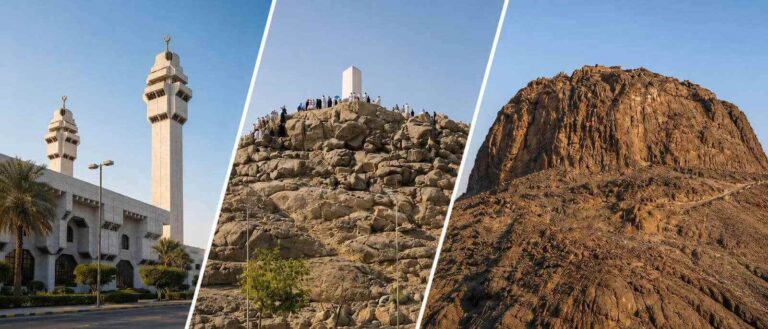
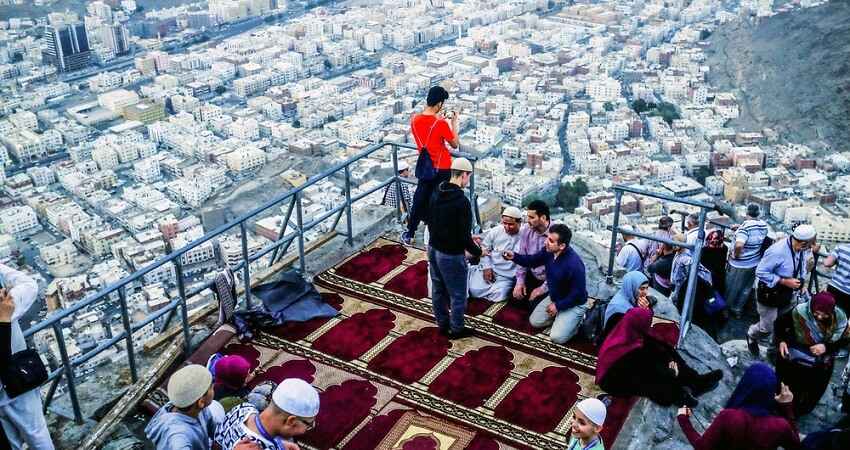
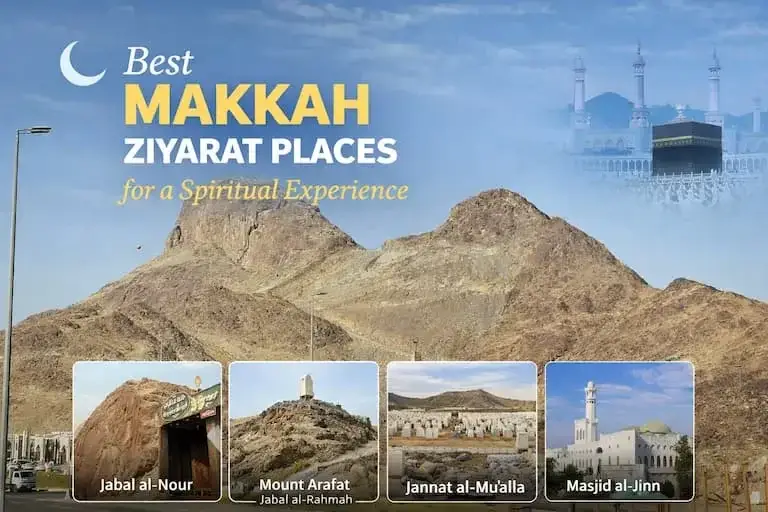
Jabal al-Noor, the “Mountain of Light”, holds the Cave of Hira, where the Prophet ﷺ used to retreat and where the first revelation came to him. It lies a few kilometres from the Haram, roughly a 15-minute drive in light traffic.
Your taxi takes you to the base. From there it is a steep climb on stone steps. Published figures for the step count and height differ from source to source, so do not rely on one number. In practice, plan about 45 minutes to an hour and a half to reach the cave, depending on fitness and rest stops, and allow similar time to come back down.
- Best window: pre-dawn or just after Fajr, when the stone is cooler and the path is calmer. Avoid the middle of the day.
- Night advice: bring a torch or use your phone light, wear grip-soled shoes, carry water, and tell your driver your expected return time.
- For elderly travellers: the climb is demanding. A comfortable alternative is to stop at the base, see the mountain, and learn the story from the roadside while the family member who cannot climb stays in the vehicle with the air conditioning on.
Jabal Thawr and the Cave of Thawr
This is the cave where the Prophet ﷺ and Abu Bakr (may Allah be pleased with him) sheltered for three nights during the Hijra. It sits south of the city centre, a drive of roughly 15 to 25 minutes from the hotel areas, and the ascent is longer and rougher than at Hira.
Treat it as a pre-dawn or Fajr-time visit only for fit climbers. For everyone else, a view from the base and a short talk about the Hijra route is a meaningful stop in itself.
Jannat al-Mu’alla
The historic cemetery of Makkah, where Khadijah (may Allah be pleased with her) and other early Muslims are buried, is close to the Haram. Access arrangements are set by the authorities and can change, and women are generally not permitted to enter. It is usually seen from the perimeter. Your driver can tell you what is allowed on the day. Visit quietly and keep voices low.
Masjid Aisha (Tan’im)
Masjid Aisha is the miqat for people already in Makkah who want to put on Ihram for an additional Umrah. It is known as the place where Aisha (may Allah be pleased with her) entered Ihram. It is open around the clock for this purpose, which makes it the most natural late-night stop on any Ziyarat route. If you plan to perform an additional Umrah, going at night and returning to the Haram before Fajr is a common and efficient plan.
A private taxi means you can change into Ihram at the mosque, pray, and travel straight back to the Haram without waiting for a ride.
Masjid Ji’ranah
Ji’ranah is another miqat for Umrah, linked to the Prophet’s ﷺ Umrah after the Battle of Hunayn. It is farther out, so the drive is closer to 30 to 40 minutes each way. Because of the distance, it fits best into a Fajr-to-morning itinerary or a late-night run when roads are clear.
Mina, Muzdalifah, Arafat, Jamarat, Masjid Nimrah and Masjid al-Khaif
These are the places of Hajj. Outside the Hajj days, the tent areas are mostly empty, which is a reason in itself to see them early, before the heat. You can drive through Mina, see the Jamarat complex from the road, pass Muzdalifah and its Masjid al-Mash’ar al-Haram, and continue to the plain of Arafat, Jabal ar-Rahmah, and Masjid Nimrah at the edge of Arafat. Masjid al-Khaif in Mina is a historic stop tied to the Prophet’s ﷺ time there.
This circuit is long. Early morning, starting after Fajr, is the sensible choice. A flexible multi-stop plan lets you decide how long to stay at each place.
A note on Hajj season: during the Hajj days, the Mash’ar area, Mina and Arafat are controlled for the pilgrimage, with movement rules and restrictions that change each year. Do not plan a casual Ziyarat route through these zones in that period. Ask your driver about current conditions.
Why a luxury SUV suits elderly family members
Our target traveller here is the family with older parents or grandparents who want the experience without the strain. A luxury SUV like the GMC Yukon makes sense for these reasons, and also has limits worth knowing.
What helps
- Easier entry and exit. An SUV sits higher than a sedan, so many older passengers find it simpler to get in and out, and to stand up again at the end of a stop.
- Room to sit comfortably. More legroom and a wider seat make long drives and waiting periods less tiring, which matters on a night tour with several short stops.
- Privacy. A private vehicle with a dedicated driver keeps the family together. Women travelling with relatives, or families who prefer a quiet cabin, often value this most.
- A smoother feel on mountain roads. Larger SUVs generally ride more softly over uneven surfaces than compact sedans. Ride quality depends on the specific vehicle and trim, so if suspension comfort is your priority, ask us which vehicle will be assigned.
- Cool interior while others climb. If one person waits in the car, air conditioning at 3 a.m. or 7 a.m. is a real benefit.
What an SUV does not change
- It cannot drive up Jabal al-Noor or Jabal Thawr. The steps remain steps.
- It cannot make the pavement flat. If wheelchair access is important to you, tell us before booking, because several Ziyarat stops are roadside or uneven, and we will plan the stops that are realistically accessible.
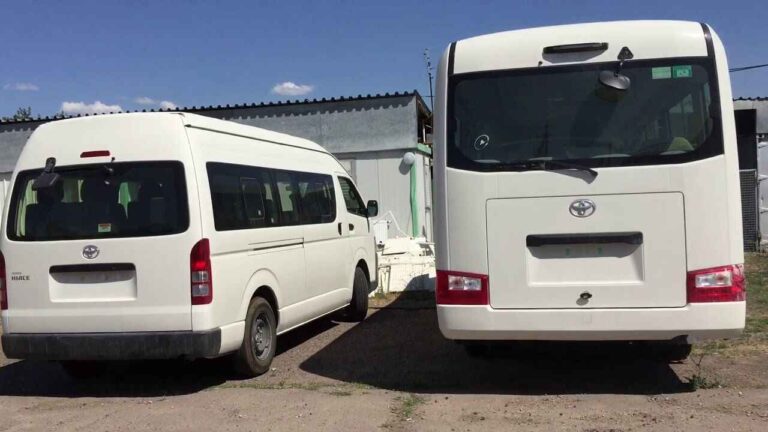
If you are travelling as a larger family, a Hyundai Staria or Toyota Hiace may suit you better. A Coaster or bus can serve bigger groups. Our fleet also includes Camry and Mercedes cars. We will recommend a vehicle by group size, luggage and mobility needs.
GMC Yukon Makkah taxi price: what decides it
We do not publish one fixed price for a Yukon Ziyarat tour, because the right quote depends on the plan. Prices you see online for luxury SUV Ziyarat trips vary widely, and the lowest number often leaves something out. Here is what actually moves the price.
- Duration: a half-day Ziyarat, a full day, or a short Masjid Aisha round trip are different jobs.
- Number of stops and distance: Hira and Thawr only is a shorter loop than a trip adding Ji’ranah, Arafat and Mina.
- Waiting time: climbs mean the driver waits. Ask for waiting time to be included in the quote.
- Hour and season: late-night and pre-dawn requests, Ramadan, school holidays and Hajj season affect availability and cost.
- Vehicle: a Yukon-class luxury SUV costs more than a sedan or a family van, in return for space and comfort.
Ask for these in writing before you confirm: the vehicle model, the pickup time, the number of stops, whether waiting time is included, and the total price. A transparent quote on WhatsApp is the best way to avoid surprises.
For a Yukon quote, message us on WhatsApp at +966 57 4915 372 with your hotel, number of passengers, preferred time and the places you want to see.
Which vehicle should you choose?
| Vehicle | Best for | Comfort notes |
|---|---|---|
| Toyota Camry / Mercedes sedan | Couples, small families, short night runs to Masjid Aisha | Comfortable for a small group; lower seat height |
| GMC Yukon (SUV) | Families with elderly members, privacy-focused travellers, luxury Umrah transport | Roomier, higher seating, strong air conditioning |
| Hyundai Staria | Medium families who want a spacious, modern cabin | Good for 5 to 7 people with luggage |
| Toyota Hiace | Larger families and small groups | Practical for group Ziyarat |
| Coaster / Bus | Big groups and organised tours | Best when many people travel together |
Seat counts vary by model and configuration, so confirm capacity when you book.
Sample night and early morning itineraries
These are starting points. A private taxi means you can change any of them on the spot.
Itinerary 1: Late-night calm (about 2 to 3 hours)
- Hotel pickup after Isha.
- Masjid Aisha: Ihram and prayer if you plan an additional Umrah.
- Drive past the Mu’alla cemetery and the Jabal al-Noor area for a roadside look.
- Return to your hotel or the Haram.
Who it suits: families with elders, first-time visitors, anyone who wants an early night.
Itinerary 2: Pre-dawn mountain visit (about 3 to 4 hours)
- Pickup around 3:00 a.m., adjusted to the season.
- Jabal al-Noor: climb for those who can; the rest wait in the vehicle.
- Jabal Thawr base or climb, depending on energy and the time left before Fajr.
- Return in time to pray Fajr at the Haram.
Who it suits: fit travellers, younger groups, and families where some members will wait comfortably in the car.
Itinerary 3: Fajr-to-morning Hajj sites (about 4 to 5 hours)
- Pray Fajr at the Haram, then meet your driver.
- Mina and the Jamarat area, then Masjid al-Khaif.
- Muzdalifah and Masjid al-Mash’ar al-Haram.
- Arafat, Jabal ar-Rahmah and Masjid Nimrah.
- Masjid Ji’ranah if time allows, then back to the hotel before the heat peaks.
Who it suits: people who want to see the Hajj sites without crowds or midday sun.
Safety and etiquette for night Ziyarat
- Travel with the family and keep your driver close. Agree a pickup point at each stop before you leave the vehicle.
- Light and footwear. Bring a torch, wear shoes with grip, and avoid slippery sandals on the mountain steps.
- Water and a light snack. Climbing without water at any hour is a mistake.
- Know your limits. Rest on the way, and do not push an elderly relative through a climb. Turning back at the right moment is the better decision.
- Respect the place. Keep your voice low, dress modestly, and follow signs and instructions at each site.
- Keep to correct belief and practice. Ziyarat is for learning and reflection. Pray and make dua as you would anywhere. Avoid practices such as wiping walls or seeking blessings from stones, which have no basis in the sunnah.
- Photography. Be considerate. Do not photograph other worshippers without permission, and follow any rules posted at a site.
- Keep valuables light. Carry only what you need and keep your hotel key card, phone and ID close.
Ramadan, peak Umrah seasons and Hajj
Ramadan. Nights are the heart of the day in Makkah. Many pilgrims spend late evening and the hours around Suhoor in or near the Haram, so roads are busy at unexpected hours. If you plan a Ziyarat tour in Ramadan, book early and ask your driver to time it around Taraweeh and Suhoor.
Peak Umrah seasons. School holidays and the months leading up to Ramadan are the busiest periods. Late-night and pre-dawn slots are in demand, so reserve ahead.
Hajj season. Parts of Mina, Muzdalifah and Arafat are restricted and heavily managed during the Hajj period. Casual Ziyarat of those areas is not appropriate then. Plan Hajj transfers separately, and confirm details with your Hajj group.
Weather. Summer pre-dawn hours are the best time for outdoor stops. In winter, mornings can be cool, so bring a light layer, particularly for older relatives.
How booking works with Makkah Ziyarat Taxi
We are a private Ziyarat taxi service in Makkah focused on pilgrims, families and visitors. This is how booking typically works:
- Message us on WhatsApp at +966 57 4915 372, or visit makkahziyarat.taxi.
- Tell us the basics: your hotel, group size, date and time, the sites you want, and any mobility needs.
- Choose a vehicle: sedan, SUV, van or bus, with a recommendation based on your group.
- Receive a clear quote and confirm the vehicle, time and stops.
- Hotel pickup: your driver meets you at your hotel and takes you door to door.
- Flexible stops: add, shorten or skip stops as the night goes on.
- Drop-off: back at your hotel or the Haram area.
Our services include private Makkah Ziyarat taxi, half-day and full-day tours, hotel pickup and drop-off, private family and group taxi, luxury Ziyarat taxi, and dedicated transfers for Cave of Hira, Jabal al-Noor, Cave of Thawr, Jabal Thawr, Jannat al-Mu’alla, Mina, Arafat, Muzdalifah, Jamarat, Masjid Aisha, Masjid Ji’ranah, Masjid Nimrah and Masjid al-Khaif.
FAQs
Can I do a Ziyarat tour in Makkah at night?
Yes. Late-night Ziyarat is possible with a private taxi, especially for roadside stops and Masjid Aisha, which is open around the clock for Ihram. Mountain climbs are better done pre-dawn or at Fajr time with a light and good shoes.
What is the best time of day for Ziyarat in Makkah?
Early morning is the most comfortable, from after Fajr until around 9 a.m., and the pre-dawn hours are best for mountain visits. In summer, avoid midday.
Is it safe to visit Jabal al-Noor at night?
Many pilgrims climb before dawn, but it requires care. Paths can be dim and the steps are uneven. Go with companions, carry a torch, wear grip shoes, and tell your driver when to expect you back.
How long does it take to climb to the Cave of Hira?
Plan roughly 45 minutes to an hour and a half going up, depending on fitness and rests, with a similar time for the descent. Reported step counts vary, so treat any single figure with caution.
Can elderly people visit Ziyarat sites?
Yes, with planning. Many stops are roadside and accessible, but the climbs to Hira and Thawr are strenuous. Elderly relatives can enjoy the base of each mountain from a comfortable vehicle, and join the stops that suit them.
How much does a GMC Yukon taxi cost in Makkah?
There is no single price. It depends on duration, number of stops, waiting time, season and the time of day. Message us on WhatsApp at +966 57 4915 372 for a written quote.
Why choose a luxury SUV for Ziyarat?
SUVs give easier entry and exit, more space, privacy and a comfortable cabin. They are well suited to elderly passengers and families who want a quiet, controlled experience.
Is Ziyarat part of Umrah?
No. Ziyarat is optional and not one of the rites of Umrah or Hajj. It is a way to learn about Islamic history and the early community of Makkah.
Can I combine Masjid Aisha with a Ziyarat tour?
Yes. Many pilgrims put on Ihram at Masjid Aisha for an additional Umrah and combine it with a few Ziyarat stops. We can pick you up after Isha, take you to Tan’im, and return you to the Haram.
Can the driver wait while I climb?
Yes, that is the main advantage of a private taxi. Ask for waiting time to be included in the quote so there are no surprises.
Do you offer hotel pickup and drop-off?
Yes. Our service is door to door from your hotel in Makkah, with flexible multi-stop trips.
Can I visit Mina, Arafat and Muzdalifah outside Hajj?
Yes, during the rest of the year they are generally accessible for viewing, and early morning is best. During the Hajj period, access is restricted, so check current conditions.
What should I bring on a night Ziyarat?
Water, a torch, grip shoes, a light jacket in winter, a phone charger, and your Ihram if you are going to Masjid Aisha or Ji’ranah.
Can women visit Jannat al-Mu’alla?
Women are generally not permitted to enter the cemetery, and arrangements are set by the authorities. Your driver can advise on the day.
Final thoughts
A Ziyarat tour does not need to be rushed, hot or crowded. Moving it to the late-night or early-morning hours gives you cooler air, calmer roads and more space to reflect, and a private vehicle gives you flexibility to stop where you want. For older family members, a comfortable SUV and a patient driver can make the difference between a hard day and a memorable one.
If you would like help planning your route, choosing a vehicle or getting a written quote, message Makkah Ziyarat Taxi on WhatsApp at +966 57 4915 372 or visit https://makkahziyarat.taxi.