
Jamarat in Makkah: Complete Ziyarat & Hajj Guide (Location, History, Rituals & Travel Tips)
Jamarat is one of the most spiritually significant and physically demanding stops on the Hajj journey. Located in the valley of Mina, just a few kilometers from Masjid al-Haram, Jamarat is where millions of pilgrims each year perform Rami al-Jamarat — the symbolic stoning of the devil, a ritual that traces back to the trials of Prophet Ibrahim (peace be upon him).
For first-time pilgrims, Jamarat can feel overwhelming: the crowds, the heat, the multi-level bridge, and the logistics of getting there and back safely. This guide walks through everything you need to know — the history, the religious meaning, the exact ritual steps, the distance from the Haram, and practical travel advice — so you can approach this sacred duty with confidence and peace of mind.
If you’re planning your Hajj or Umrah itinerary and want a stress-free way to reach Jamarat and Mina, a private Makkah Ziyarat taxi can make the journey far more comfortable than relying on crowded public transport, especially for families, elderly pilgrims, or those with mobility needs.
What Is Jamarat?

Jamarat (also spelled Jamraat or Jamarah) refers to three stone structures located in Mina, a valley roughly 8 kilometers from the Kaaba. Each pillar represents a location where, according to Islamic tradition, Shaytan (Satan) attempted to tempt Prophet Ibrahim (AS) to disobey Allah’s command to sacrifice his son, Ismail (AS). At each location, Ibrahim rejected the temptation and pelted Shaytan with seven stones — an act pilgrims re-enact today as a declaration of obedience to Allah and rejection of evil.
The three pillars are:
- Jamarat al-Sughra (the Small Jamarah) — closest to Masjid al-Khaif and farthest from Makkah.
- Jamarat al-Wusta (the Middle Jamarah) — positioned between the small and large pillars.
- Jamarat al-Aqabah / al-Kubra (the Large Jamarah) — closest to Makkah, where the ritual begins on the 10th of Dhul Hijjah.
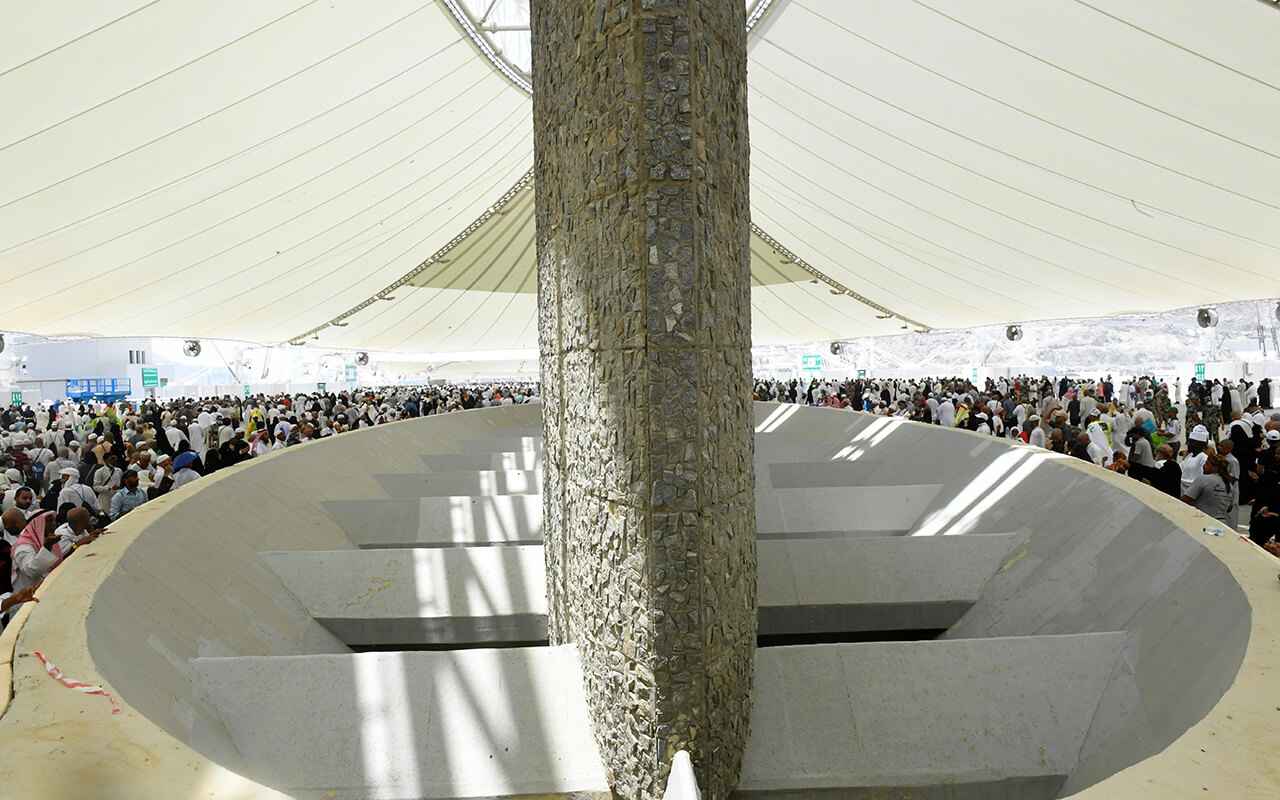
In the modern Jamarat complex, each pillar has been rebuilt as a long elliptical wall surrounded by a wide catchment basin, replacing the original obelisk-shaped pillars to allow safer pelting by large crowds. The three walls sit in a line, spaced roughly 116–156 meters apart, and are connected by the multi-level Jamarat Bridge, completed in 2010 and engineered to accommodate several hundred thousand pilgrims per hour.
The Religious Significance of Jamarat

Rami al-Jamarat is one of the essential rites of Hajj, rooted in the story of Prophet Ibrahim (AS). Islamic tradition holds that as Ibrahim prepared to fulfill Allah’s command to sacrifice his son, Shaytan appeared to him three times at what are now the three Jamarat locations, trying to dissuade him. Each time, Ibrahim responded by throwing seven stones and driving Shaytan away.
For pilgrims today, the stoning is more than a physical act — it is a spiritual declaration. Scholars describe it as an expression of complete submission to Allah, performed without needing to rationalize the command, and as a personal renewal of the pilgrim’s intention to resist temptation, whether it takes the form of pride, greed, anger, or despair.
When Is Jamarat Performed? (Days of Hajj)
Rami al-Jamarat takes place over several days during Hajj, following a specific order:
- 10th of Dhul Hijjah (Eid al-Adha / Yawm al-Nahr): Pilgrims stone only Jamarat al-Aqabah (the large pillar) with seven pebbles.
- 11th, 12th, and 13th of Dhul Hijjah (Ayyam al-Tashreeq): All three pillars are stoned in order — starting with Jamarat al-Sughra (small), then al-Wusta (middle), then al-Aqabah (large). After the small and middle pillars, pilgrims pause to face the Qiblah and make dua. After the large pillar, they leave without lingering.
Most pilgrims complete their stoning by the 12th, though some remain for the 13th depending on their Hajj type and personal circumstances.
How Far Is Jamarat From Masjid al-Haram?
Jamarat is located in Mina, approximately 7 to 8 kilometers from the Kaaba inside Masjid al-Haram. On foot, covering this distance typically takes around 2 hours, depending on the route, crowd density, and the pilgrim’s pace. By road, using King Fahad Road or similar routes, the journey by taxi or private car during non-peak periods can take as little as 15–20 minutes — though during the days of Hajj itself, road closures and pedestrian-only zones mean much of the movement around Mina and Jamarat is done on foot or via the official Hajj train and bus network.
This is one of the biggest planning challenges pilgrims face: during Hajj, private vehicle access into the Mina and Jamarat area is heavily restricted for safety and crowd control. However, outside the peak Hajj days — for pilgrims performing Umrah with an extended Ziyarat itinerary, or visiting Mina, Muzdalifah, and Arafat as historical and spiritual sites rather than during the Hajj rites — a private taxi is by far the most practical, comfortable, and time-efficient way to reach the area, especially when combining the visit with other Islamic landmarks such as the Cave of Hira, Jabal al-Noor, or Masjid Al-Khaif.
This is where booking a private Ziyarat taxi through Makkah Ziyarat Taxi becomes genuinely useful — our drivers know the road access points, timing patterns, and pickup zones around Mina, helping you avoid unnecessary walking and confusion, particularly for families, elderly travelers, or anyone visiting Jamarat and the surrounding sites outside the main Hajj rush.
How to Perform Rami al-Jamarat: Step-by-Step
- Collect your pebbles — Traditionally gathered from Muzdalifah, roughly the size of a chickpea. Many pilgrims also collect them near Mina if needed.
- Head to the correct pillar — On the 10th, go directly to Jamarat al-Aqabah. On the following days, start with the small pillar and move toward the large one.
- Face the pillar and throw seven pebbles one at a time, saying “Allahu Akbar” with each throw.
- Pause for dua after the small and middle pillars, facing the Qiblah with hands raised.
- Do not linger after the large pillar — Leave the area promptly to ease congestion for others.
- Use the Jamarat Bridge levels — The five-level bridge structure helps distribute crowds; follow directional signage and official guidance at all times.
Visitor Etiquette and Safety Tips
- Avoid peak crowd hours. Early morning and late evening are generally less congested than midday.
- Stay hydrated and protect against the sun — Mina’s open valley offers little shade, and Hajj typically occurs in intense heat.
- Never rush or push. Crowd crush incidents have occurred historically at Jamarat; move calmly and follow crowd-control staff instructions.
- Keep young children and elderly relatives close, or consider having them wait in a safer, less congested area while a designated family member performs the stoning.
- Carry identification and your Hajj permit at all times.
- Photography is generally discouraged during the ritual itself out of respect for the sanctity of the act and to avoid slowing crowd movement — save photos for less congested moments.
Elderly, Wheelchair, and Family Accessibility
The modern Jamarat Bridge was specifically redesigned with accessibility in mind, including ramps and multiple levels to reduce strain on pilgrims with limited mobility. Even so, the sheer scale of the crowds during peak Hajj days makes independent travel difficult for elderly pilgrims or those with health conditions.
Many families choose to arrange private, unhurried transport for the portions of their journey that don’t require walking through restricted pedestrian zones — for example, transfers to and from Mina camps, hotel pickups before and after the Hajj days, or visits to nearby sites like Masjid Al-Khaif. A private family taxi with a professional driver allows the group to travel together, at a manageable pace, without depending on shared shuttles or long waits.
Recommended: Jabal Thawr
Traveling to Mina, Jamarat, Arafat, and Muzdalifah
Jamarat doesn’t exist in isolation — it’s part of the broader Hajj route that includes Mina, Arafat (about 14 kilometers from Mina), and Muzdalifah (situated between Arafat and Mina). During the official days of Hajj, transport between these sites is tightly coordinated through designated buses, trains, and walking routes for safety and crowd management.
Outside of the Hajj period, however, many Umrah pilgrims and visitors choose to include Mina, Arafat, and Muzdalifah in an extended Ziyarat tour to understand the geography and history of the Hajj rites, even if they aren’t performing Hajj that season. For this kind of visit, a private taxi transfer is the most flexible option, since it allows you to:
- Visit Mina Taxi Transfer, Arafat Taxi Transfer, and Muzdalifah Taxi routes in one flexible, multi-stop trip
- Stop at Masjid Nimrah and Masjid Al-Khaif along the way
- Set your own pace without being tied to group tour schedules
- Return comfortably to your Makkah hotel afterward
Makkah Ziyarat Taxi offers exactly this kind of door-to-door, multi-stop Ziyarat service, with hotel pickup and drop-off included, so you can see the historic Hajj sites without the stress of navigating unfamiliar routes on your own.
Best Time to Visit Jamarat (Outside Hajj Days)
For pilgrims and travelers wanting to see the Jamarat complex and Mina valley as part of a general Ziyarat tour (rather than during the active Hajj rites), early morning or late afternoon offers cooler temperatures and lighter traffic. Ramadan and the weeks surrounding Umrah season tend to bring higher numbers of visitors to Makkah overall, so booking transport in advance is advisable during these peak periods.
Recommended Vehicles for Ziyarat Trips to Mina and Jamarat
Depending on your group size and comfort preferences, different vehicles suit different needs:
- Sedan (e.g., Toyota Camry) — Ideal for solo travelers or couples wanting a comfortable, air-conditioned ride.
- SUV (e.g., GMC Yukon) — A good fit for small families wanting extra space and a smoother ride.
- Family Van (e.g., Hyundai Staria, Toyota Hiace) — Well-suited for larger families or small groups traveling together with luggage.
- Coaster or Bus — Practical for larger groups or organized Ziyarat tours visiting multiple sites in one day.
Makkah Ziyarat Taxi maintains a fleet of new-model, air-conditioned vehicles across these categories, allowing you to choose the right option for a half-day or full-day Ziyarat tour that includes Mina, Jamarat, and other historic Islamic landmarks.
How to Book a Private Taxi for Jamarat and Mina Ziyarat
Booking is straightforward:
- Decide which sites you want to include — for example, Mina, Jamarat, Arafat, Muzdalifah, or a combination with the Cave of Hira and Jabal al-Noor.
- Contact Makkah Ziyarat Taxi via WhatsApp at +966 57 4915 372 with your preferred date, group size, and hotel location.
- Confirm your vehicle choice and itinerary — hotel pickup and drop-off are included.
- Enjoy a flexible, door-to-door Ziyarat experience at your own pace, with a professional driver familiar with the routes and timing around Mina.
Whether you need a private family taxi, a luxury Ziyarat taxi, or a full-day tour combining several historical sites, the team at makkahziyarat.taxi can help build an itinerary that fits your schedule and comfort needs.
FAQs
1. What is Jamarat in simple terms?
Jamarat refers to three stone structures in Mina where pilgrims performing Hajj throw pebbles as part of the ritual of Rami al-Jamarat, symbolizing the rejection of Shaytan’s temptation, following the tradition of Prophet Ibrahim (AS).
2. How far is Jamarat from Masjid al-Haram?
Jamarat is approximately 7 to 8 kilometers from the Kaaba. Walking typically takes around two hours, while driving outside of restricted Hajj periods can take 15–20 minutes.
3. How many pebbles are needed for Rami al-Jamarat?
Pilgrims generally need 49 pebbles if leaving Mina after the 12th of Dhul Hijjah, or 70 pebbles if staying through the 13th, thrown seven at a time at each pillar.
4. Can non-Hajj pilgrims visit Jamarat?
Umrah pilgrims and general visitors can view the Jamarat complex and Mina valley as part of a Ziyarat tour outside the official Hajj rites, though the ritual of stoning itself is specifically part of Hajj.
5. Is it safe to travel to Jamarat?
Yes, when following official crowd-control guidance and avoiding peak congestion times. The modern multi-level Jamarat Bridge was built specifically to improve pilgrim safety and flow.
6. Can I take a taxi directly to Jamarat during Hajj?
During the official days of Hajj, vehicle access into Mina and the Jamarat area is heavily restricted for safety reasons, and movement is largely on foot or via official transport. Private taxis are best used for transfers before and after the Hajj days, or for general Ziyarat visits outside the Hajj period.
7. What is the best time of day to perform Rami al-Jamarat?
Early morning and evening hours tend to have lighter crowds and cooler temperatures compared to midday.
8. Are there separate paths for elderly or disabled pilgrims?
The Jamarat Bridge includes ramps and multiple levels designed to ease movement, though families are still encouraged to plan extra time and support for elderly or less mobile relatives.
9. What should I wear or bring to Jamarat?
Comfortable footwear, sun protection, water, identification, and your Hajj permit are essential. Avoid carrying unnecessary bags that could be difficult to manage in dense crowds.
10. How do I get from my Makkah hotel to Mina for Ziyarat?
Outside the restricted Hajj days, a private Ziyarat taxi with hotel pickup and drop-off is the most convenient way to travel between your hotel and Mina, Jamarat, and nearby sites like Masjid Al-Khaif.
11. Can I combine a Jamarat/Mina visit with other historical sites in one trip?
Yes. Many visitors combine Mina, Arafat, and Muzdalifah with sites like the Cave of Hira, Jabal al-Noor, or Masjid Aisha in a single flexible, multi-stop Ziyarat tour.
12. How much does a private Ziyarat taxi cost?
Pricing depends on vehicle type, group size, and the number of stops on your itinerary. Contact Makkah Ziyarat Taxi via WhatsApp for a tailored quote based on your specific plan.
13. Do I need to book a Ziyarat taxi in advance?
Booking ahead is recommended, especially during Ramadan and peak Umrah season, to ensure vehicle availability and a driver familiar with your preferred route.
14. What is the difference between Jamarat al-Sughra, al-Wusta, and al-Aqabah?
They are the small, middle, and large pillars respectively, stoned in that order on the 11th, 12th, and 13th of Dhul Hijjah, with only the large pillar (al-Aqabah) stoned on the 10th.
15. Is Jamarat the same as Mina?
No. Mina is the broader valley and tent city where pilgrims stay during Hajj, while Jamarat refers specifically to the three pillars located within Mina where the stoning ritual takes place.
Final Thoughts
Jamarat represents one of the most meaningful acts of devotion in the entire Hajj journey — a physical re-enactment of faith, obedience, and the rejection of temptation. Understanding its history, timing, and logistics in advance helps pilgrims approach the ritual with focus rather than stress over crowds or transportation.
For the portions of your journey that call for comfort and flexibility — hotel transfers, pre- and post-Hajj Ziyarat visits, or exploring Mina, Arafat, and other historic Islamic sites at your own pace — a private taxi can make a meaningful difference, especially for families and elderly travelers.
To arrange a private Ziyarat taxi, hotel pickup, or a custom multi-stop itinerary around Makkah, reach out to Makkah Ziyarat Taxi on WhatsApp at +966 57 4915 372, or visit https://makkahziyarat.taxi to plan your trip.


