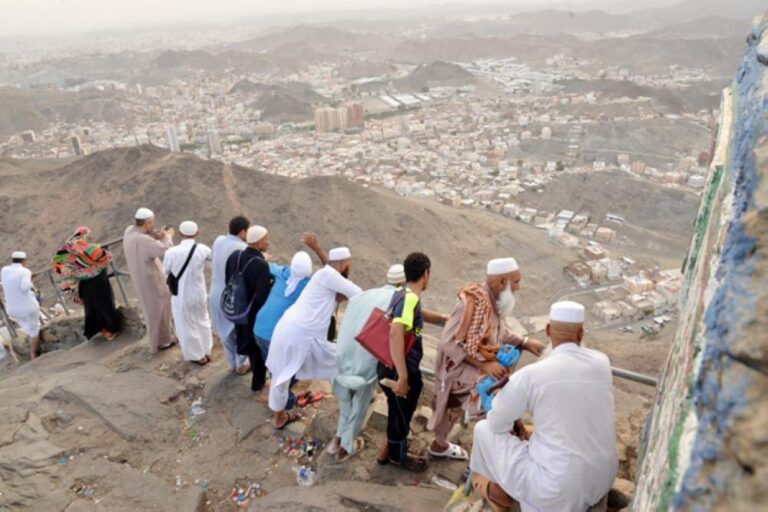

Arafat Makkah Ziyarat Guide: History, Significance, Location & How to Visit
Arafat, also known as Jabal al-Rahmah (the Mountain of Mercy), is one of the most spiritually significant sites in Islam and a central pillar of Hajj. Located on a wide, open plain roughly 20–21 kilometres southeast of the Holy Kaaba, Arafat is where millions of pilgrims gather every year on the 9th of Dhul Hijjah for the Day of Arafat, the day the Prophet Muhammad ﷺ delivered his Farewell Sermon.
This guide explains everything visitors, Hajj pilgrims, and Umrah travelers need to know about Arafat: its history and religious importance, how far it is from Masjid al-Haram, the best way to get there, what to expect on site, and practical tips for a smooth and meaningful visit. Whether you are performing Hajj this year or simply want to visit the Plain of Arafat during Umrah for reflection, this article covers the complete picture — and how to arrange comfortable private transportation for the trip.
Quick answer: Arafat is about 20–21 km southeast of Masjid al-Haram, with a typical drive time of 25–40 minutes outside of Hajj peak movement. During Hajj itself, managed traffic and pilgrim flows can extend travel time significantly, so private, well-planned transport is strongly recommended.
What Is Arafat and Why Is It Important?

Arafat (Arabic: عرفة / عرفات) refers to a vast plain east of Makkah that surrounds a small granite hill called Jabal al-Rahmah, or the “Mount of Mercy.” The hill itself rises about 70 metres above the surrounding plain, reaching an elevation of roughly 454 metres above sea level.
Arafat holds a unique place in Islamic history and ritual:
- It is widely regarded as the location of the Prophet Muhammad’s Farewell Sermon (Khutbat al-Wada), delivered during his final Hajj.
- Muslim tradition also associates the area with the reunion of Prophet Adam and Hawwa (Eve) after their descent to Earth.
- The “standing at Arafat,” known as Wuquf, is considered the single most essential rite of Hajj. A well-known hadith states that “Hajj is Arafat” — meaning that without presence at Arafat on the appointed day, the pilgrimage is not valid.
Because of this, Arafat is not simply a historical landmark but an active ritual site that every Hajj pilgrim must visit, and one that many Umrah travelers choose to see out of reverence and curiosity when time allows.
The Day of Arafat: What Happens There

On the 9th of Dhul Hijjah, pilgrims travel from Mina to the Plain of Arafat, arriving before noon. The day unfolds as follows:
- Dhuhr and Asr prayers are combined and shortened, traditionally led near Masjid Nimrah, located a short distance southwest of the hill.
- Wuquf (the standing) takes place from the time the sun passes its zenith until sunset. Pilgrims spend these hours in prayer, supplication (dua), recitation of the Quran, and sincere repentance.
- At sunset, pilgrims depart for Muzdalifah to spend the night under the open sky before continuing the remaining rites of Hajj — collecting pebbles, moving to Mina, and performing the stoning of the Jamarat.
The Day of Arafat is widely considered one of the holiest days in the Islamic calendar, and many Muslims who are not performing Hajj that year choose to fast on this day as an act of worship.
How Far Is Arafat From Masjid al-Haram?
A question many pilgrims and visitors ask is exactly how far Arafat is from the Haram and how long the journey takes.
- Straight-line distance: approximately 18–20 km from the Kaaba.
- Road distance: approximately 20–21 km via standard driving routes.
- Typical driving time: 25–40 minutes in normal traffic conditions.
- Distance from Mina to Arafat: approximately 14 km.
- Walking distance: roughly 20–28 km depending on the exact pedestrian route, taking anywhere from 4.5 to 6.5 hours on foot. Some pilgrims walk sections of the journey, though very few walk the entire distance given the heat and physical demands.
During normal (non-Hajj) periods, a private taxi from Makkah to Arafat is a straightforward 25–40 minute drive. During the days of Hajj itself, however, road closures, one-way pilgrim corridors, and enormous crowd volumes mean that travel times can extend well beyond the normal estimate — which is exactly why advance planning and a driver who understands the seasonal routes matter so much.
Getting to Arafat: Transportation Options
There are several ways to reach Arafat from Makkah, Jeddah, or your hotel:
- Organized Hajj group transport — Buses arranged as part of an official Hajj package, generally scheduled around fixed group timings.
- Public transport / Mecca Metro (Al Mashaaer Line) — Operates seasonally during Hajj and connects the holy sites, though it runs on a specific schedule tied to the pilgrimage days rather than year-round general use.
- Private taxi or private vehicle — The most flexible option for pilgrims, families, and visitors who want to travel on their own schedule, with door-to-door pickup and a dedicated vehicle rather than shared transport.
For travelers outside of the fixed Hajj movement — for example, those visiting the Plain of Arafat during Umrah, or pilgrims who need a reliable ride to and from Arafat, Mina, or Muzdalifah around their group’s schedule — a private Ziyarat taxi offers far more comfort, privacy, and flexibility than shared transport. You can book a private Makkah Ziyarat taxi through makkahziyarat.taxi, with hotel pickup and drop-off included, so you are not left waiting in the heat or navigating unfamiliar routes on your own.
Why Private Transport Makes Sense for Arafat and the Hajj Sites
- Flexible timing: You are not bound to a fixed group departure or return time.
- Door-to-door comfort: Pickup directly from your Makkah hotel and drop-off back at your accommodation.
- Family and elderly-friendly: Private vehicles are far easier for elderly pilgrims, families with children, or anyone with mobility concerns than crowded shared buses.
- Multi-stop convenience: A private driver can combine a visit to Arafat with nearby sites such as Masjid Nimrah, Muzdalifah, Mina, and the Jamarat in a single, well-planned trip.
- Air-conditioned vehicles: Given the intense heat of the Arafat plain, especially during summer Hajj seasons, a comfortable, air-conditioned sedan, SUV, or van (such as a Camry, Hyundai Staria, Toyota Hiace, or GMC Yukon) makes a significant difference over long waits for shared transport.
Makkah Ziyarat Taxi arranges Arafat taxi transfers, Mina taxi transfers, and Muzdalifah taxi service for individuals, families, and groups, alongside private tours of the broader Makkah Islamic historical sites — allowing pilgrims to plan a comfortable, unhurried itinerary rather than rushing between fixed timings.
Visiting Arafat Outside of Hajj
Because Wuquf is only performed during the official Hajj days, many people wonder whether Arafat can be visited at other times of the year.
Outside of the Hajj season, the plain and Jabal al-Rahmah are generally quieter and more accessible, and some Umrah pilgrims choose to visit for reflection, dua, and to see the site where the Farewell Sermon took place. There are no ritual obligations tied to visiting outside Hajj — it is simply an opportunity to see a historically significant location connected to the life of the Prophet ﷺ. If you would like to include Arafat in a broader Ziyarat itinerary alongside sites like the Cave of Hira, Jabal al-Noor, or the Cave of Thawr, a half-day or full-day private Ziyarat tour makes it easy to see several locations without the logistics of arranging separate transport for each stop.
Best Time to Visit
- During Hajj (8th–13th Dhul Hijjah): Arafat is at its most crowded and logistically complex; movement is tightly managed by Saudi authorities, and independent travel is restricted to official pilgrim routes and timings.
- Outside Hajj season: The site is calmer, and a private taxi can reach Arafat comfortably within the normal 25–40 minute drive time from Makkah.
- Time of day: Early morning or late afternoon is generally cooler and more comfortable for visiting, particularly in the summer months when temperatures on the open plain can be extreme.
- Ramadan: Arafat itself is not part of standard Ramadan Ziyarat routes (since Hajj occurs in Dhul Hijjah), but many Umrah pilgrims combine a Ramadan Umrah trip with a Ziyarat tour of Makkah’s historical sites during quieter daytime hours.
Practical Visitor Tips
- Stay hydrated: The plain of Arafat offers little natural shade; carry water and use an umbrella or hat, especially during summer Hajj seasons.
- Wear comfortable footwear: Even with private transport to the site, you will likely walk on uneven, sunbaked ground.
- Plan around prayer times: Dhuhr and Asr are combined at Arafat during Hajj; if visiting outside Hajj, check standard local prayer schedules.
- Respect the etiquette of the site: Arafat is treated with reverence; keep noise and disruption to a minimum, particularly near areas used for dua and reflection.
- Photography: Photography is generally accepted around the plain and the hill itself, but be mindful of other worshippers, especially during moments of collective supplication.
- Accessibility: For elderly travelers or those with limited mobility, a private vehicle that can get as close as possible to the site is far more practical than relying on long walks from public transport drop-off points.
- Book transport in advance during Hajj: Given the scale of pilgrim movement, arranging a private Ziyarat taxi ahead of time — rather than trying to find transport on the day — makes the journey considerably less stressful.
Nearby Sites Worth Visiting
A trip to Arafat is often combined with other key Hajj-related and historical locations nearby:
- Masjid Nimrah — Located near Arafat, associated with the site of the Farewell Sermon and the combined Dhuhr/Asr prayer.
- Muzdalifah — Between Arafat and Mina, where pilgrims spend the night under the open sky and collect pebbles for the Jamarat.
- Mina — Known as the “City of Tents,” the site of the Jamarat (stoning of the pillars) and several days of the Hajj rites.
- Masjid al-Khaif — Located in Mina, another significant mosque connected to Hajj history.
Because these sites sit along the same general route, a private taxi is especially useful for combining stops — for example, an Arafat and Muzdalifah transfer on the same trip, or a Mina taxi transfer paired with a visit to Masjid al-Khaif. Makkah Ziyarat Taxi offers flexible, multi-stop Ziyarat trips designed around exactly this kind of route, so pilgrims are not arranging separate transport for each location.
Booking a Private Taxi to Arafat
If you are planning to visit Arafat — whether as part of official Hajj movement support, an Umrah-season Ziyarat trip, or a family visit to the historical sites of Makkah — a private taxi offers a simpler, more comfortable alternative to shared or public transport.
Makkah Ziyarat Taxi provides:
- Private Arafat taxi transfers
- Mina and Muzdalifah taxi transfers
- Jamarat taxi service
- Combined Makkah Islamic historical site tours (Cave of Hira, Jabal al-Noor, Cave of Thawr, Jabal Thawr, Jannat al-Mu’alla, and more)
- Hotel pickup and drop-off
- Private family and group taxis, including luxury vehicle options
- Half-day and full-day Ziyarat tours with flexible, multi-stop routes
To check routes, vehicle options, or availability, visit makkahziyarat.taxi, or message directly on WhatsApp at +966 57 4915 372 to arrange pickup times and confirm your itinerary. Booking ahead — especially during Hajj season — helps ensure a driver and vehicle are reserved for your specific timing.
FAQs
1. How far is Arafat from Masjid al-Haram?
Arafat is approximately 20–21 km from Masjid al-Haram by road, with a typical drive time of 25–40 minutes outside peak Hajj movement.
2. What is the significance of Arafat in Islam?
Arafat is the site of the “standing” (Wuquf) on the 9th of Dhul Hijjah, considered the most essential rite of Hajj, and is traditionally associated with the Prophet Muhammad’s Farewell Sermon.
3. Can I visit Arafat outside of Hajj season?
Yes. While the ritual of Wuquf only takes place during Hajj, the plain and Jabal al-Rahmah can be visited at other times of the year for reflection, often as part of a broader Ziyarat tour.
4. What is Jabal al-Rahmah?
Jabal al-Rahmah, or the “Mount of Mercy,” is the small granite hill at the center of the Plain of Arafat where pilgrims gather during Hajj.
5. How do pilgrims travel from Mina to Arafat?
Pilgrims typically travel the roughly 14 km from Mina to Arafat by organized bus transport, the seasonal Mecca Metro (Al Mashaaer Line), or on foot along designated pilgrim routes.
6. Is it possible to book a private taxi to Arafat?
Yes. Private Ziyarat taxi services, such as those offered through Makkah Ziyarat Taxi, provide door-to-door transport to Arafat, Mina, Muzdalifah, and other Hajj-related sites, with flexible timing outside of fixed group schedules.
7. What should I bring when visiting Arafat?
Water, sun protection (hat, umbrella, sunscreen), comfortable walking shoes, and modest clothing suitable for prayer and worship.
8. How long do pilgrims stay at Arafat?
Pilgrims generally arrive before noon on the 9th of Dhul Hijjah and remain until sunset, when they depart for Muzdalifah.
9. Is Arafat suitable for elderly visitors or those with mobility issues?
The open, uneven terrain can be challenging, so private transport that minimizes walking distance is strongly recommended for elderly pilgrims or anyone with mobility concerns.
10. What is Masjid Nimrah’s connection to Arafat?
Masjid Nimrah sits near Arafat and is traditionally associated with the location of the Farewell Sermon and the combined Dhuhr/Asr prayer performed during the Day of Arafat.
11. Can Arafat be combined with other Ziyarat sites in one trip?
Yes. Many pilgrims combine Arafat with nearby locations such as Muzdalifah, Mina, and Masjid al-Khaif in a single multi-stop private tour.
12. Why is traffic to Arafat heavier during Hajj days?
During the official Hajj period, Saudi authorities manage enormous pilgrim volumes through dedicated routes and timings, which can significantly extend normal travel times compared to the rest of the year.
13. What vehicles are available for a private Ziyarat taxi to Arafat? Options typically include sedans (such as a Camry), family vans (Hyundai Staria, Toyota Hiace), and larger SUVs (GMC Yukon) depending on group size and comfort preferences.
14. Do I need to book Arafat transport in advance?
It is strongly recommended, particularly during Hajj season, since demand for transport rises sharply and advance booking helps secure a driver and vehicle for your specific schedule.
15. How can I book a private Ziyarat taxi to Arafat?
You can book directly through makkahziyarat.taxi or by messaging WhatsApp at +966 57 4915 372 to arrange pickup, vehicle type, and itinerary.
Final Thoughts
Arafat stands at the spiritual heart of Hajj — a place of standing, supplication, and reflection that every pilgrim experiences at least once. Whether you are preparing for the Day of Arafat as part of Hajj, or hoping to visit the plain during a quieter Umrah trip, understanding the distance, timing, and transport options will make the journey far smoother.
For a comfortable, flexible way to reach Arafat, Mina, Muzdalifah, or any of Makkah’s Islamic historical sites, a private Ziyarat taxi remains the most convenient option — with hotel pickup, door-to-door service, and a pace set around your own schedule rather than a fixed group timetable. Visit makkahziyarat.taxi or reach out on WhatsApp at +966 57 4915 372 to plan your Arafat transfer or full Ziyarat itinerary.