Complete Guide to Visiting Jabal Thawr & Historical Sites in Makkah
Jabal Thawr, the rugged mountain south of Makkah that holds the Cave of Thawr (Ghar Thawr), is one of the most meaningful stops on any Ziyarat itinerary. It was here that Prophet Muhammad ﷺ and his companion Abu Bakr As-Siddiq (RA) sheltered for three nights during the Hijrah, the migration from Makkah to Madinah in 622 CE. For pilgrims and visitors who want to stand where this story unfolded, understanding the location, the terrain, and the best way to get there matters as much as knowing the history itself.
This guide covers everything a visitor needs before booking a Jabal Thawr taxi tour: the history of Ghar Thawr, how far it actually is from Masjid al-Haram, how long to plan for photos and quiet reflection at the base, and how to combine the visit with Arafat and Mina in a single private taxi package.
The History of Jabal Thawr and the Cave of Thawr

When the Quraysh of Makkah plotted to kill Prophet Muhammad ﷺ, he and Abu Bakr (RA) left the city under cover of night. Rather than heading directly north toward Madinah, they moved south, away from the expected route, and hid in a small cave near the summit of Jabal Thawr for three days while Quraysh search parties combed the surrounding hills.
Islamic tradition describes how the search party reached the very mouth of the cave. Abu Bakr, fearing for the Prophet’s safety, is reported to have expressed his anxiety, to which the Prophet ﷺ responded with the words later reflected in the Qur’an: that they were not alone, for God was with them. According to widely told accounts, a spider had spun a web across the entrance and a dove had nested nearby, so the search party assumed no one had entered recently and moved on.
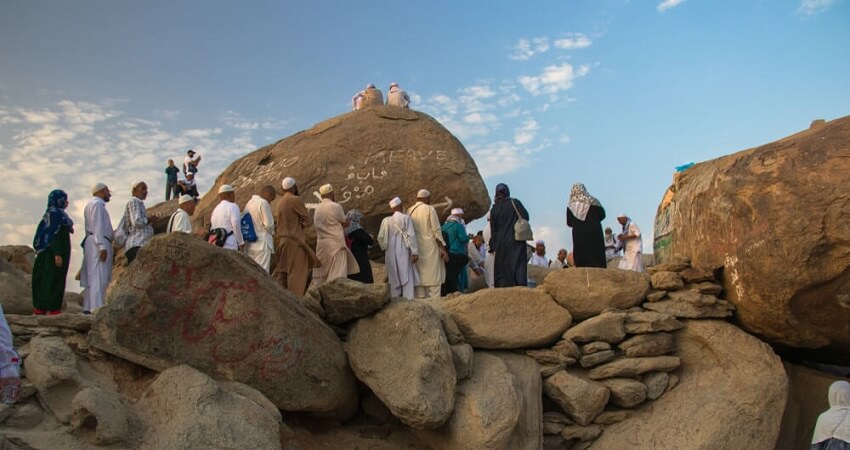
The name “Thawr” means “bull” in Arabic, and historians note the mountain may have taken its name either from this resemblance or from a man named Thawr ibn Abd Manaah who once lived in the area. Today the cave sits near the mountain’s peak, a modest hollow in the rock with two small openings, one facing east and one west, so narrow that visitors must crouch or turn sideways to look inside.
Because of this history, Jabal Thawr is regarded as one of the most significant historical Islamic landmarks in Makkah, alongside the Cave of Hira on Jabal al-Noor, where the first revelation came to the Prophet ﷺ before his prophethood. The two caves are often visited together, though they sit on opposite sides of the city and require separate trips.
Where Is Jabal Thawr? Ghar Thawr Location Explained
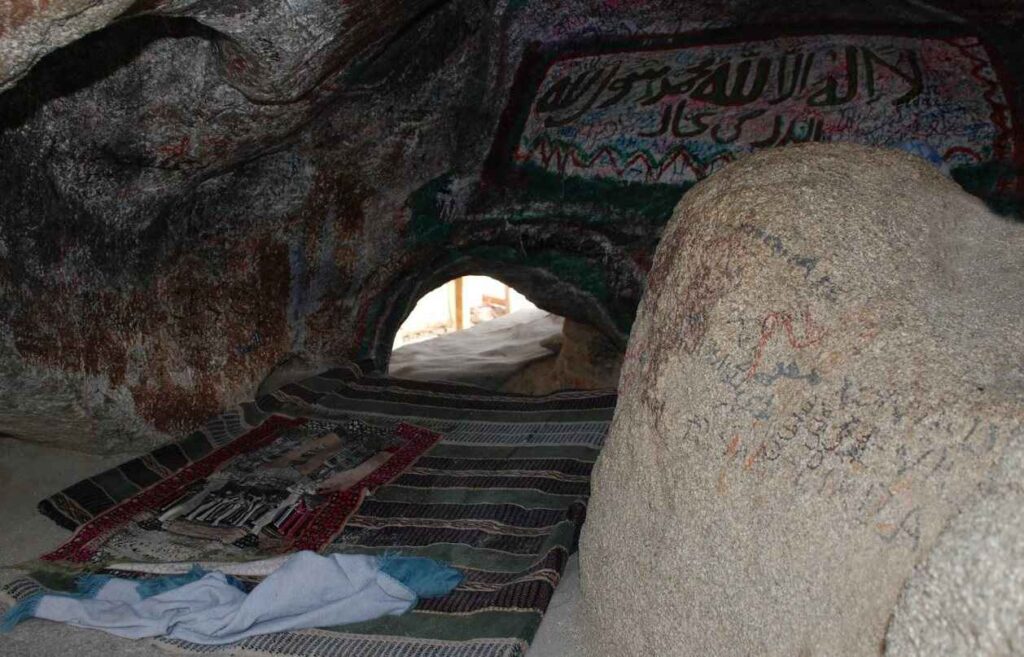
Jabal Thawr is located to the south of Makkah, in the direction of the old route toward Yemen, and sits within the wider Hejaz mountain range. Distance estimates vary depending on whether they measure a straight line or the actual driving route, so you will see different figures across travel guides:
- Straight-line distance from Masjid al-Haram: commonly cited as roughly 4–5 kilometers.
- Driving distance by road: typically closer to 8–12 kilometers, since the route winds around the base of the surrounding hills.
- Elevation: the mountain rises to approximately 750–760 meters above sea level.
In practical terms, a private taxi from central Makkah or from your hotel near Masjid al-Haram to the base of Jabal Thawr generally takes around 15–25 minutes, depending on traffic, your starting point, and the time of day. This is one of the reasons a private Jabal Thawr taxi tour is worth planning ahead of time rather than relying on shared transport, which rarely serves this route directly.
The Jabal Thawr Cultural District, developed at the base of the mountain, now offers signage, lighting, and paved sections that make the area more accessible than it was in the past, along with historical context about the Hijrah before visitors approach the trail.
What to Expect When You Arrive
Unlike Masjid al-Haram or the Jamarat complex, Jabal Thawr is not a developed religious site with facilities built around it. It is, first and foremost, a natural mountain. When your taxi drops you at the base:
- You will find a car park and viewing area where most visitors take photographs of the mountain and read information panels about the Hijrah story.
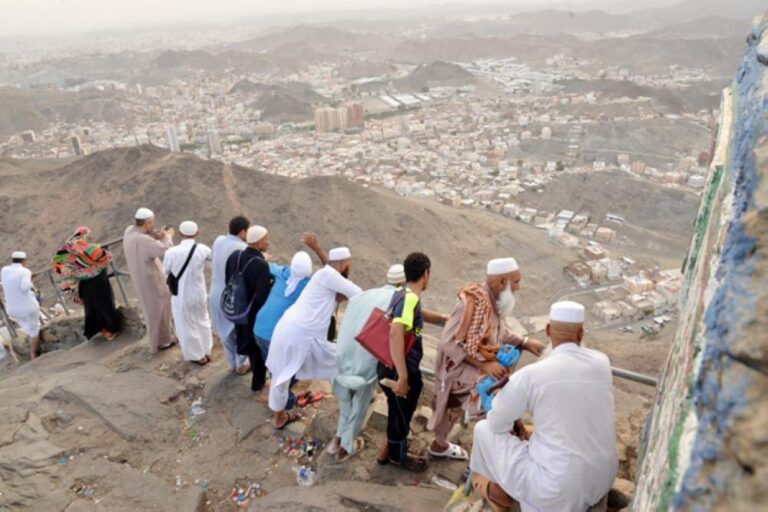
- A marked trail leads toward the summit for those who wish to climb.
- Basic amenities near the base may be limited, so carrying water is important, especially in warmer months.
Many visitors, particularly families, elderly travelers, or anyone on a tighter schedule, choose to view the mountain from the base rather than attempt the climb. This is a completely acceptable way to complete the Ziyarat, since the historical and spiritual significance of the site is not diminished by staying at ground level.
How Long to Spend at Jabal Thawr
Plan your stop based on whether you intend to climb:
- Viewing from the base only: 20–40 minutes is usually enough for photographs, reading the historical information at the Cultural District, and a few quiet minutes of reflection.
- Climbing partway for better photos: 45–90 minutes, depending on fitness level and how far up the trail you go.
- Climbing to the Cave of Thawr: 2–3 hours round trip is realistic for most visitors, given the steep, rocky terrain.
Because the time required can vary so much between a quick photo stop and a full climb, this is one of the clearest reasons to travel with a private taxi rather than a scheduled group tour. A private driver can wait at the base for as long as you need, whether that is twenty minutes or three hours, without rushing your visit or leaving you to arrange separate return transport.
Should You Climb to the Cave?
The climb to the Cave of Thawr is widely described as the most demanding hike among Makkah’s historical Ziyarat sites, more difficult than the walk up Jabal al-Noor to the Cave of Hira. The path is steep, rocky, and largely unshaded, and reaching the cave typically takes between two and three hours round trip.
Before deciding to climb, consider:
- Physical condition: the terrain is uneven and requires sustained effort; it is not recommended for anyone with heart, joint, or respiratory conditions, or for elderly travelers with mobility concerns.
- Footwear: sturdy, closed athletic shoes are essential; sandals or worn footwear increase the risk of injury.
- Heat: Makkah’s climate makes mid-afternoon climbing genuinely risky; mornings or the hours closer to sunset are safer.
- Hydration and pacing: carry more water than you think you need, and take regular breaks.
If climbing is not realistic for your group, viewing Jabal Thawr from the base, learning the Hijrah story at the Cultural District, and taking photographs of the mountain is a meaningful and complete way to experience the Ziyarat, especially when paired with other historical sites on the same trip.
Getting to Jabal Thawr: Transport Options
Public transportation does not serve Jabal Thawr directly, and the area is far enough from Masjid al-Haram that walking is not practical for most visitors. In practice, travelers reach the site in one of three ways:
- Ride-hailing apps, which can be inconsistent in this area and may involve waiting for a return ride once you are ready to leave the base.
- Group Ziyarat bus tours, which visit Jabal Thawr as one stop among several on a fixed schedule, often with limited time at each location.
- A private Ziyarat taxi, booked directly with a driver who takes you to Jabal Thawr, waits while you view the site or climb, and then continues to your next stop or back to your hotel.
For most families, elderly travelers, and pilgrims who want flexibility around prayer times and rest, a private Makkah Ziyarat taxi is the most practical option. It removes the uncertainty of waiting for a ride back from a remote mountain base and allows the schedule to move at your pace rather than a fixed tour timetable. Visitors can book a Jabal Thawr taxi tour through Makkah Ziyarat Taxi, with hotel pickup and drop-off included as standard.
Combining Jabal Thawr with Arafat and Mina
Because Jabal Thawr sits somewhat apart from the main cluster of Ziyarat sites near central Makkah, many visitors choose to combine it with other significant locations on the same day rather than making a separate trip. A common and efficient private taxi route links:
- Jabal Thawr – the Hijrah refuge, viewed from the base or climbed depending on time and fitness.
- Arafat – the plain where pilgrims stand during Hajj, and a site many visitors like to see even outside the Hajj season for its historical and spiritual weight.
- Mina – the valley of tents associated with the days of Hajj, often visited alongside Arafat given their proximity along the same route.
This combination works well in a private taxi because all three sites sit along a broadly similar corridor south and east of the city, unlike the Cave of Hira or Jannat al-Mu’alla, which are closer to central Makkah. A half-day or full-day Ziyarat tour covering Jabal Thawr, Arafat, and Mina together is one of the more efficient ways to see this cluster of historically significant locations without doubling back across the city multiple times. Makkah Ziyarat Taxi offers flexible multi-stop Ziyarat trips built around exactly this kind of route, so the order and pace of stops can be adjusted around prayer times, rest breaks, and how long you choose to spend at each location.
Other Historical Places in Makkah Worth Visiting
A private Ziyarat taxi also makes it practical to see several other landmarks connected to early Islamic history, either as an extension of a Jabal Thawr trip or as a separate outing:
- Cave of Hira (Jabal al-Noor) – where the first revelation came to the Prophet ﷺ; generally an easier climb than Jabal Thawr.
- Masjid Aisha (Masjid at-Tan’im) – the miqat point where many pilgrims enter ihram for Umrah.
- Masjid Ji’ranah – another miqat location with its own historical significance.
- Masjid Nimrah – near Arafat, associated with the Farewell Sermon.
- Masjid Al-Khaif – located in Mina, historically significant during Hajj.
- Jannat al-Mu’alla – the historic cemetery in Makkah where several of the Prophet’s family members are buried.
- Muzdalifah and Jamarat – both tied to the rites of Hajj and often visited together with Mina and Arafat.
Because these sites are spread across different parts of the city, travelers who want to see more than one or two locations in a day generally find a private taxi far more efficient than public transport or fixed-route buses, which rarely cover this exact combination of stops.
Best Time to Visit Jabal Thawr
- Time of day: early morning, shortly after sunrise, offers cooler temperatures for anyone planning to climb, along with softer light for photography. Late afternoon before sunset is a good alternative for those only viewing from the base.
- Season: cooler months (roughly November through February) make the climb noticeably more manageable than the peak summer heat.
- Ramadan: many visitors prefer to schedule Ziyarat trips outside of fasting hours, typically in the morning or shortly after Iftar, when energy levels are higher and roads are less congested around Maghrib.
- Hajj season: this period brings heavy traffic across the entire Mina, Arafat, and Muzdalifah corridor, which also affects routes near Jabal Thawr. Booking a private taxi with a driver familiar with local traffic patterns during these weeks is particularly useful.
Visitor Etiquette and Practical Tips
- Dress modestly and comfortably, in clothing suited to walking and climbing if you plan to reach the cave.
- Keep noise to a minimum near the base and along the trail out of respect for the site’s history and for other visitors in quiet reflection.
- Carry sufficient water, sun protection, and snacks, since facilities at the site are limited.
- Avoid attempting the climb alone; travel with at least one companion.
- If traveling with elderly family members or young children, plan on viewing from the base rather than attempting the full climb, and let your driver know in advance so the stop can be timed accordingly.
- Photography is welcome at the base and along the lower trail, but be mindful of other pilgrims and avoid disrupting anyone engaged in quiet prayer or reflection.
Booking a Private Jabal Thawr Taxi Tour
Given the distance from central Makkah, the limited public transport options, and the flexibility needed to accommodate climbing time, prayer breaks, and combining stops with Arafat and Mina, most visitors find that a private Ziyarat taxi is the most comfortable and reliable way to experience Jabal Thawr.
Makkah Ziyarat Taxi provides private, air-conditioned transportation for exactly this kind of itinerary, with a fleet that includes sedans such as the Camry and Mercedes for smaller groups, along with the Hyundai Staria, Toyota Hiace, GMC Yukon, Coaster, and full-size buses for families and larger groups. Drivers are familiar with the local routes connecting Jabal Thawr, Arafat, Mina, and Makkah’s other historical sites, and trips include:
- Hotel pickup and drop-off
- Flexible waiting time at each stop, including at the base of Jabal Thawr
- Half-day and full-day Ziyarat tour options
- Vehicles suited to private family travel or larger private group travel
To plan a Jabal Thawr taxi tour, combine it with Arafat and Mina, or build a broader multi-stop itinerary around your schedule, visit makkahziyarat.taxi or message directly on WhatsApp at +966 57 4915 372 to arrange pickup times, vehicle selection, and your preferred route.
FAQs
How far is Jabal Thawr from Masjid al-Haram?
Straight-line distance is roughly 4–5 kilometers, though the actual driving route is longer, typically around 8–12 kilometers, taking about 15–25 minutes by private taxi depending on traffic.
Can I visit Jabal Thawr without climbing to the cave?
Yes. Many visitors view the mountain and learn the Hijrah story from the base and the Jabal Thawr Cultural District without attempting the climb, which is a complete and meaningful way to complete the Ziyarat.
How long does the climb to the Cave of Thawr take?
Reaching the cave and returning typically takes 2–3 hours round trip, on a steep and rocky trail. It is considered more demanding than the climb to the Cave of Hira on Jabal al-Noor.
Is Jabal Thawr suitable for elderly visitors or young children?
The climb itself is not recommended for elderly travelers, young children, or anyone with heart, joint, or respiratory conditions. Viewing the site from the base is a suitable alternative.
What should I wear or bring for the visit?
Sturdy, closed athletic shoes, comfortable modest clothing, sun protection, and enough water for the length of your visit, especially if you plan to climb.
Is public transport available to Jabal Thawr?
Public transport does not serve the site directly. Most visitors arrive by ride-hailing app, group bus tour, or private Ziyarat taxi.
Can I combine Jabal Thawr with Arafat and Mina in one trip?
Yes, this is a common and efficient private taxi route, since all three sites sit along a similar corridor outside central Makkah. A half-day or full-day tour can cover all three stops.
What is the best time of day to visit?
Early morning is best for anyone planning to climb, due to cooler temperatures. Late afternoon before sunset works well for a base-level visit and photography.
Is Jabal Thawr open all day?
As a natural mountain site rather than a managed facility, Jabal Thawr does not operate on fixed visiting hours, though climbing after dark is not advisable for safety reasons.
How does Jabal Thawr differ from the Cave of Hira?
Both are tied to major events in the Prophet’s ﷺ life, but Cave of Hira on Jabal al-Noor relates to the first revelation before prophethood, while the Cave of Thawr relates to the Hijrah migration. Jabal Thawr’s climb is generally considered more difficult and receives fewer visitors as a result.
Do I need to book a taxi in advance for Jabal Thawr?
Booking ahead is recommended, particularly if you plan to combine the visit with other stops like Arafat and Mina, since this allows the driver to plan waiting time and route order around your schedule.
Is Jabal Thawr relevant to Hajj, or only Umrah pilgrims?
Jabal Thawr is a historical Ziyarat site connected to the Hijrah, separate from the ritual sites of Hajj such as Arafat, Muzdalifah, and Mina, though many visitors choose to see all of them together given their geographic proximity.
Can a private taxi wait while I climb to the cave?
Yes, private Ziyarat taxis such as those offered by Makkah Ziyarat Taxi allow flexible waiting time, so the driver can remain at the base while you climb and return, rather than working around a fixed group schedule.
Are there facilities like restrooms or shops near Jabal Thawr?
Facilities at the base are limited compared to central Makkah, so it is best to carry water and any essentials you may need before setting out.
What language do Ziyarat taxi drivers typically speak?
Drivers working with private Ziyarat taxi services in Makkah generally communicate in Arabic and English, with familiarity with common phrases in other languages spoken by international pilgrims.